Yearly Archives: 2009

Selecting a BI Package – Proof of Concept

The selection of a BI software package can be a difficult process to go through. There are alot of things to consider when making such a decision such as what your specific needs are as an organization, what skill sets your organization has available for support, hardware considerations, and cost. Here are a few ideas that might be useful when selecting your next Business Intelligence solution.

  1. Determine what hardware and operating systems the package is compatible with. Have the sales team document and lay this out up front, so you know if you have the skillset, software licenses, and hardware to use the package in the first place.
  2. Further layout what the additional costs will be for procuring software/hardware, purchasing support, and hiring or training a proper skill set. This will help you get to a total cost of ownership. Understand what the annual support fee structure is like.
  3. Make sure to walk through the development process. Often times, proof of concepts revolve around software capabilities, but it is just as important to look under the hood. A complicated development process can lead to many problems down the road for development and maintenance. Not all development processes are created equal.
  4. Every BI tool seems to come with a license for each function of the software. Licensing can get pretty complicated, so make sure you understand what each license covers. It really helps to lay it out in some form of spreadsheet, so you can total up how much licensing will cost based on what you select.
  5. Understand the capabilities of each package, simplify them into common terms across all packages, and attempt to compare these capabilities, apples to apples. Such capabilities might include OLAP, caching, scheduling, delivery, pixel perfect reporting, dashboarding capabilities, report development interface, user interface, architecting process, SQL generation, etc.
  6. Understand the technology behind the OLAP that is being delivered and determine if this will serve your organization adequately. Is the technology multi dimensional OLAP or relational OLAP? Multi dimensional OLAP performs faster, but also requires that data be stored physically on the platform. Relational OLAP may be slower, but sits directly on your EDW and usually is more flexible when expanding the scope of data that is to be reported. HOLAP which is a hybrid OLAP utilizes relational OLAP, but also allows for caching of data which can improve performance. Beware that caching may be sold as a multi-dimensional OLAP alternative, but there are limitations to caching’s effectiveness. In the past this was mainly limited by the RAM size of your BI server, but as technology advances, caching becomes more and more useful.
  7. Is it important to develop a proof of concept on your own data? It is definitely nice to see your data within a sales presentation, but building a POC directly on an EDW will most likely not be possible. Most vendors will ask for downloads of data that they will then store locally on their laptop for demo purposes. Because this is normally the case, the only real benefit of doing this is so that the business can see a presentation in terms they can understand. Don’t expect to gain any other type of insight about a product because they are using your data in the POC….unless they actually decide to develop on your EDW.

Well, that’s all I can think of for now. Cheers.
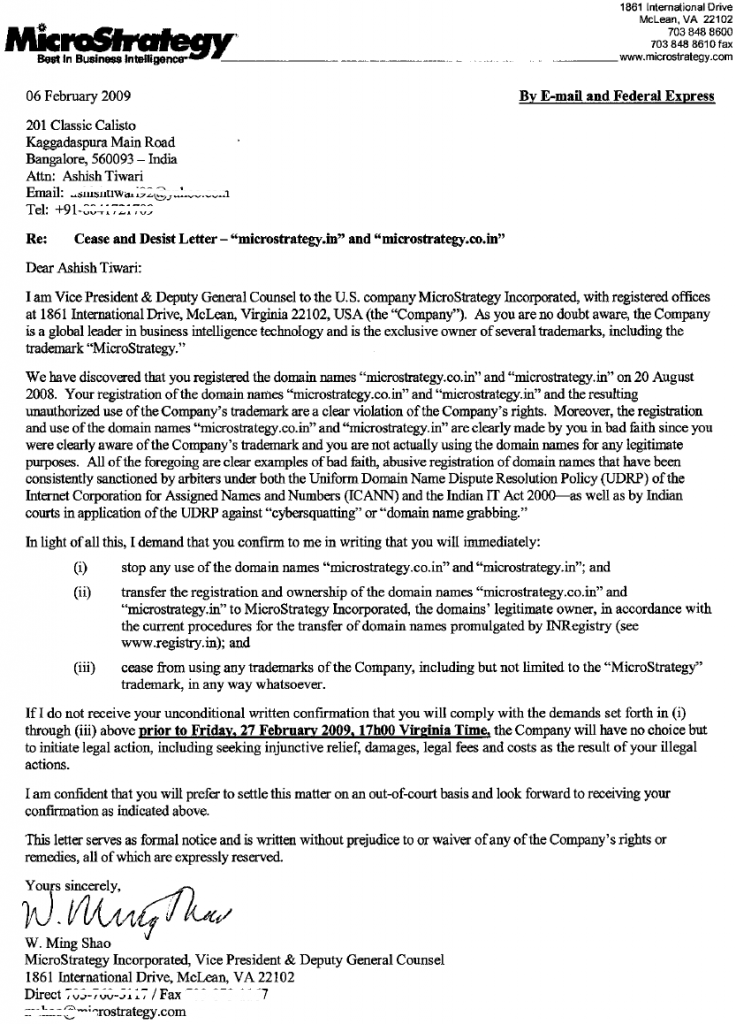
Cease and Desist letter from MicroStrategy, Inc

Few friends wanted to see a copy of the letter received from MicroStrategy, Inc. Here is the copy.

MicroStrategy Cease and Desist

MicroStrategy Cease and Desist

This is the biggest pain reliever I’ve in my life. Whenever I feel sad, I open copy of this letter to forget everything and laugh. Simply can’t believe MicroStrategy, Inc would do such a thing to me. Sometime legal/para legal ways are not the best way to do things. I pity on MicroStrategy, Inc having hired visually handicapped people, miserably unfit to do their jobs, reached position of VP and para legal. 😐

Last but not least, never received the promised letter by FadEx, something extremely critical to pursue the case against the current domain name holder.

MicroStrategy Interview Questions revisited

Recently I had to revist the 101 MicroStrategy Interview Question bank and I realized that there were a lot of repeated questions, not so useful question, etc. I scrubbed the questions and here is new improved set. Remember: these are with prospective of an Interviewer. If you have your won question bank and wish to publish, comment here. I’ll contact you. Full credit given. 😎

Warehouse

  1. What is fact constellation schema?
  2. What is star schema?
  3. What is snowflake schema?
  4. What is a surrogate key?
  5. Why do we use a staging area?
  6. Why do we need a DW?
  7. How much history should we have in a DW?
  8. What are the most important tables in a DW?
  9. Why Kimball? Why not Inmon? Or vice versa?
  10. Performance with a relational based query vs dimensional?
  11. What schema is used in your project? Why?
  12. What are conformed dimensions?

General Knowledge (Applies to all roles)

  1. What is metadata?
  2. What is two-tier connection?
  3. What is three-tier connection?
  4. What is difference between 2, 3 and 4 tier connections?
  5. How do you achieve schema object version control (similar to VSS)?
  6. What are different kinds of objects in MicroStrategy?
  7. What’s fact table?
  8. Where is Administrator’s password stored? Is it stored in encrypted?
  9. Why do we use dimensional modeling in DW? Why not Relational?
  10. What is a batch?
  11. Differences between ROLAP, MOLAP and HOLAP?
  12. What is ETL?
  13. What types of DW’s are most common?
  14. How many MSTR projects have you worked?
  15. What are the types of MSTR objects available?
  16. Explain the step-by-step technical approach after you get the Requirements from the Client.
  17. What’s a System call error? Have you seen Object variable error?
  18. Have you ever manually edited the metadata? why?

Architect

  1. Should you have DATE as ID attribute form?
  2. What is compound key?
  3. What is a fact and an attribute?
  4. What are Factless facts?
  5. What are Transformations? Is there any transformations implemented in your project?
  6. Explain Fact Structure(types, one by one)
  7. Explain Level Extension. How it is used in your project?
  8. Explain Fact Relation.
  9. Explain Fact Degradation.
  10. What is Compound Key Attribute? Give example from your project.
  11. Can you update a table in Warehouse using MicroStrategy?
  12. How will you resolve an issue when (by chance) an aggregate table at higher level has a higher LTS than an aggregate table at lower level?
  13. What happens if LTS is high for a higher level table?
  14. What are the criteria used by the MicroStrategy SQL Engine to build the join tree of a report’s SQL?
  15. Can MicroStrategy logical primary keys and the true (warehouse) primary keys differ?
  16. Oracle has a pseudo column named ROWID which is not “directly” exposed to front-end? Can this table be used in MicroStrategy? Why one would do that?
  17. Can you create Schema objects in 2 tier connection? Is it recommended?

Reporting

  1. What is the difference between RW document and HTML document?
  2. What’s smart metric?
  3. What is a bridge/relationship table?
  4. How will you resolve double counting in M-M relationship between two attributes?
  5. What is a CUBE?
  6. What are differences between View Filter and Report Filter?
  7. What are the different types of Filters available? Explain each with example.
  8. What is derived metrics? Explain the example from your project.
  9. What are Prompted Filters or cascaded prompts?
  10. How will you customize the display for Null Values?
  11. Can you enable/disable the thresholds based on some condition/prompt answers?
  12. In a Document, there are 5 reports and 5 out of them need to have a prompt so that 10 user can select first day of the week for which user want to execute the report. How many prompts would be required to be made?
  13. What’s XML Cache?
  14. What’s a Bulk export report?
  15. Can you have a prompt in free form SQL report?
  16. What will happen when the network connection between the webserver and one of the clustered I-server is lost? Will report run smoothly?
  17. Can you prioritize report execution?

 Administration

  1. What is ScanMD?
  2. What is MD Doctor?
  3. What is clustering?
  4. How will you reset password of all users?
  5. What are different modes you can run I-Server?
  6. How can you make sure that I-Server would be running even if the application mode has crashed and how to get back the instance?
  7. What are various authentication modes?
  8. How can you configure WH authentication?
  9. Does DLS affect MicroStrategy? What you need to do incorporate it?
  10. What is Object Manager?
  11. What will you do when I-Server crashes?
  12. What will you do if your Administrator has forgotten password or the account is locked?
  13. How can you monitor the error received while running I-Server and report?
  14. Attribute role, Security role, Security filter and Access control?
  15. How to create an event based schedule?
  16. Can MicroStrategy be installed on Solaris or UNIX w/o Root access? Can such a server be (re)started?
  17. If you have a Quad core CPU and MSTR license to use CPUs, can you set to use two particular cores dedicatedly for I-Server (As other core may have been programmed for some other dedicated work)
  18. Drawbacks on 4GT switch?
  19. Can you cap the number of reports run at a time by users? What happens when this limit is breached?
  20. Can you some how disable Web users to use only one I-Server?

Narrowcast Server

 Looking for questions.

 Web SDK

  1. Can you make a floating window in MicroStrategy Web?
  2. How to have two images in MicroStrategy login page?
  3. Can you apply themes to MicroStrategy Web? How to create a one?
  4. After a bulk export report is run, NCS puts it on an ftp location? Can this location be directly made available in MSTR web?

 Desktop SDK

 Looking for questions.

Reply to MicroStrategy about domain Cease and Desist

This one is from archive. Totally missed. Someone holding the position of VP at MicroStrategy, Inc. sent me the cease and desist letter about owing domains – microstrategy.co.in and microstrategy.in. I was totally shocked about having received such a warning and I was very much laxed about a reply thinking what can they do. Even if NIXI (manages the .IN Registry) awards the domain to, I would take a court stay. But that was a wrong thinking. I was just browsing the ICANN site about replying a domain name C&D notice and I came to know that mere not replying (in 20 calendar days – as per set rules) to C&D notice is sufficient for a domain owner to lose the domain forever, which could not be challenged to the domain registry or ICANN (rare of rare exception). One can read the site of ICANN about how to answer a domain name cease and desist letter. As per ICANN, all the allegation must be replied, else you may lose your case. A complainant may have several charges and all should be replied.

BTW, as per letter received from MicroStrategy, Inc. they had sent the cease and desist letter to my postal address, which I happen to have left just a month before. I have duly notified my registrar about the domain, but whois is still shows the old addresses Said offline letter was never received to the address and thus as per ICANN rules they loose the case. A complainant must send the cease and desist online (which they did) as well as offline, a very strict rule of ICANN. They will have to show the Registrar a proof of delivery of offline notice, who will arbitrate the domain ownership dispute.

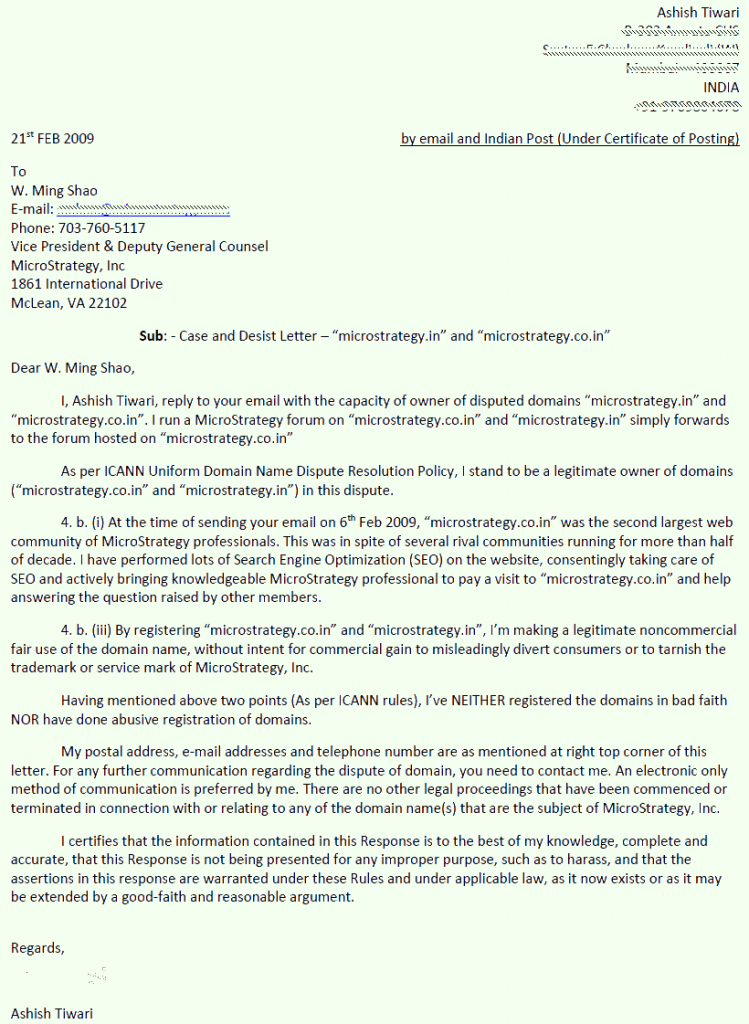
Have a look at the reply of cease and desist letter received from MicroStrategy, Inc.

MicroStrategy Ceased and Desist REPIED

MicroStrategy Cease and Desist REPIED

Something I would never forget that there was 20 time increase in the spam on my MicroStrategy forum which coincided reply to the cease and desist letter. Since February and till June, I’ve spent considerable amount of time deleting spam from forum. It is very hard alone handling lot of things. MicroStrategy, Inc also started allowing any register user with support  account, accessing the official MicroStrategy forum too, only after the above sent reply. :mrgreen: . I had to go to extent of allowing post to contain spam and I’ve found that to be the best ant-spam too for a forum based on phpBB. Worst impact, the forum lost the popularity and MicroStrategy official forum gained very much; but now the trend has got reversed in last 2 months. Something to be happy.
P.S. – Don’t get annoyed by the reply. As per ICANN domain name dispute. cease and desist notice must be replied with specific words and sentences.

Finally Indian Govt dept uses MicroStrategy

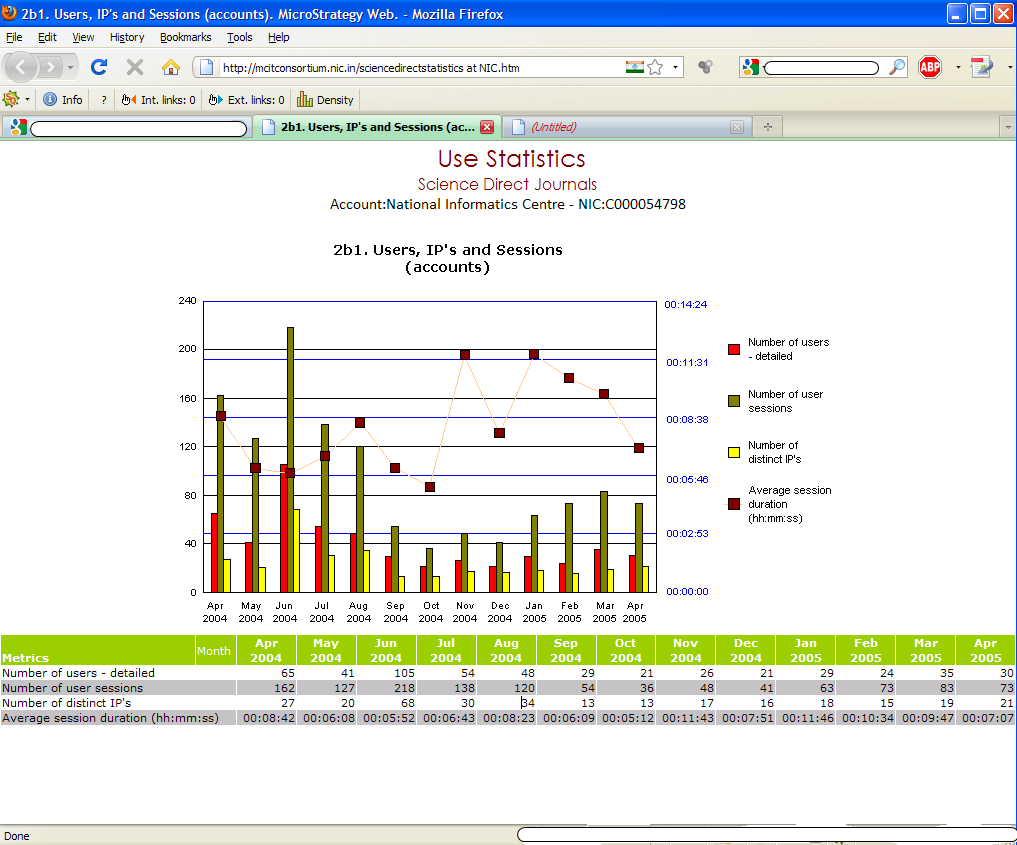
I was searching about the presence of MicroStrategy in India and I stumbled upon this page. Snaspshot of the page is as below:

Science Direct Library Service usage by NIC

Science Direct Library Service usage by NIC

After some browsing I also came to know how to browse to this page too. It is Home -> Statistic -> Y (for NIC).

Now look closely to the report, it is a MicroStrategy grid graph report. Grid auto-style is small. Grid look and feel is exactly like a MicroStrategy report. I really don’t know that’s a legal installation of MicroStrategy. The reports is of year 2006 and the site is never updated after that. Indian govt employees are like; they would sell the free stuff to Govt too (to corner tax payer’s money). Finally there is one more MicroStrategy client in India.

If you have any idea about this, do share.